
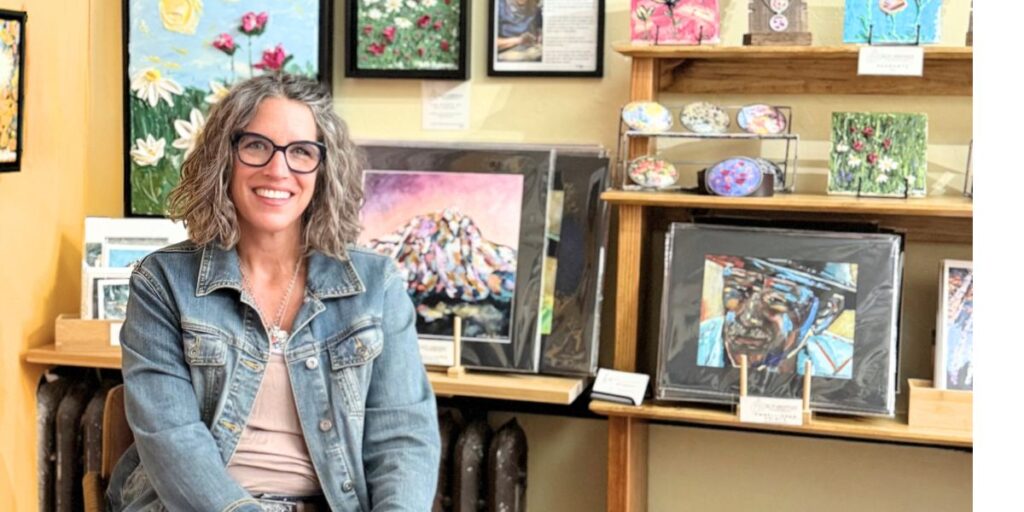
Recently I spoke with Beth Anderson, founder of The 9318 Collective in Silverton, Colorado – a retail art space where local artists sell their work, and support one another. Her entrepreneurial journey spans two decades of creating art, pursuing a long-held dream of building a collaborative artist space, and navigating the challenges of starting a business during COVID. In our conversation, Beth shares how The 9318 Collective fosters a strong sense of community among local artists and the community, the importance of supporting one another through growth and challenges, lessons learned from pivoting her business model, and the realities of running a seasonal enterprise. Beth offers inspiring advice for young entrepreneurs on taking risks, following your instincts, and embracing opportunities.
Background and the Spark for Entrepreneurship
Griffin Connolly: Welcome Beth, let’s start with your story. Can you tell me a little about your background and how you found your way into entrepreneurship?
Beth Anderson: My art journey started close to 20 years ago. About 12 years back, I was living in Pennsylvania and working as an artist on the tri-state festival circuit. I had a group of friends who dreamed of starting an artist co-op together. But life threw a wrench in those plans, and we eventually ended up moving to Colorado. At that point, I set the dream aside and told myself it was time to get a “real job.” So, I started selling real estate.
Then about five years ago, my husband Brian told me there was a space for rent in Silverton that I had to check out. Honestly, I thought he was a little crazy — I didn’t know why I’d want something like that. But he said, “You’re going to open your art studio.” And that’s really where it all began.
Griffin Connolly: That’s such a great story. Can you share more about what motivated you to actually start the art collective in Silverton?
Beth Anderson: I had spent about ten years trying to build my art business and realized that having a physical storefront presence can really help you succeed. The challenge, of course, is that if you’re running a storefront by yourself, you’re spending all your time running the shop instead of making art.
That’s when I realized there had to be other artists like me who were looking for a place to sell their work locally — without having to manage everything alone. So, the idea was to create a community of like-minded artists who could share a space, support one another, celebrate each other’s successes, and brainstorm through challenges together. Growth and change are always hard, but having a group around you makes it so much easier.
Building Community Through The Art Collective
Griffin Connolly: That’s a perfect segue into my next question. One of the main themes I’m exploring with entrepreneurship is community, and your endeavor aligns with this perfectly. Community seems to be a big part of both Silverton and your collective. Can you talk a little about why community is so important to you and how The 9318 Collective fosters that sense of connection?
Beth Anderson: Absolutely. It’s been a journey. I opened The Collective in June of 2020 — right in the middle of COVID. My dream was always for it to operate as a cooperative rather than just a store, but at that time, that wasn’t realistic. So, for the first two years, it ran as a traditional storefront.
By the end of the second season, I was completely burned out. I remember waking up in the middle of the night thinking, “This is your business. If you hate what you’re doing, you need to change it.” That was the turning point. I decided that the next season, we would transition into a true cooperative model and bring in other artists to help run the space.
Now, we have around 20 local artists represented in about 1,000 square feet — and even local kids sell their work! What’s been most rewarding is seeing the relationships that have formed. We know about each other’s lives — family illnesses, travels, little victories. It’s become more than a store; it’s a network of friends, almost like an extended family.
Beyond supporting the artists in the Collective, we also want to give back to the Silverton community. Silverton is a small mountain town, and I love finding ways for everyone to get involved in the creative process. We offer a makerspace and host art lessons for locals and tourists of all ages, so people can explore their creativity, learn new skills, and connect with the artistic community. It’s been amazing to see how this helps bring people together and inspires the next generation of artists. We also participate in the Silverton Art Walk on the first Friday of the month which brings a lot of new faces into town. These community events play a vital role in small towns.
Lessons Learned and Challenges of Seasonality
Griffin Connolly: You touched on this earlier when you talked about launching during COVID, which was a tough time for businesses everywhere, but looking back from when you started to now, is there anything you would have done differently?
Beth Anderson: Honestly, I think I need to be grateful that I signed the lease back in 2019 — if I hadn’t, I probably wouldn’t have done it at all, and the opportunity would have passed me by. As far as doing things differently, I would have implemented the cooperative model sooner rather than later. That’s the only thing I really look back on and think I’d change.
Otherwise, I don’t have any big regrets or major mistakes. The business has been great — we’ve grown every year, both in the number of artists we represent and financially.
Our biggest challenge is the seasonality of Silverton — we’re only open for six months out of the year, from May to October. During the winter months Silverton mostly closes down. The roads can be closed due to snow fall and the Durango-Silverton train doesn’t run. Most of the local economy is dependent on tourists and thousands of them arrive on the train every year. This gives us the opportunity to engage with a wider audience, but it also means when those people aren’t arriving most businesses don’t stay open.
November 1st is our last day open this season. By that point, everyone is exhausted — we’ve had a busy summer with lots of tourists, which is wonderful, but we’re ready for a break. At the same time, it’s frustrating because you can’t help but think, “If we could just double our open season, we could really grow this thing.” But that’s the reality of Silverton — it’s just not an economy that runs year-round.
Griffin Connolly: The collective model is pretty unique — you all volunteer to help out in the store. Does that ever pose challenges, like finding people to cover shifts, or is it pretty consistent?
Beth Anderson: For the most part, they figure it out themselves. Over the years, I’ve had a few people who didn’t really fit the model, but they ended up weeding themselves out. The group we have now really looks out for me — probably more than they’d admit. They keep an eye on the schedule and make sure the days are covered. I’m still there more than everyone else, but that’s how it should be. Of course, we all have days where someone misses a shift or a meeting, but overall, we’ve worked out the kinks.
The Most Fulfilling Part of the Journey
Griffin Connolly: You mentioned earlier that you had dreamed of starting an art collective for a long time before finally opening your space in Silverton. Now that you’ve been running it for several years, what do you find most fulfilling about entrepreneurship and the work you’re doing?
Beth Anderson: Witnessing everyone else’s success has been the most fulfilling part. Seeing people blossom has been incredible. Being an artist is such a strange thing — so many of us struggle with imposter syndrome and have a hard time even introducing ourselves as artists.
But when you put people in a space like The 9318 Collective, it’s like watching their wings unfold. Their confidence grows, their work improves, and they start interacting with customers in a whole new way. That transformation — seeing them own their identity as artists and thrive — is what keeps me going.
How the Space — and Vision — Have Evolved
Griffin Connolly: You mentioned earlier that you started during COVID, which was a unique time for both businesses and communities. Can you talk about some of the things that have changed over the years you’ve been in this collaborative environment and in the art space in particular?
Beth Anderson: Oh, definitely. When I first started, nobody really knew each other — it was basically just a bunch of art in a room. The biggest change has been the relationships. Over time, the artists have gotten to know one another, not just what everyone makes, but why they make it. That understanding and connection have transformed the space from just a store into a real community.
Griffin Connolly: That makes so much sense. Have you thought about expanding into neighboring communities like Durango, or are you pretty set on staying in Silverton?
Beth Anderson: I’ve thought about it a lot — and people ask me why I don’t open in Durango, which is our closest bigger town. Honestly, I’d love to have a space there, but the biggest reason I don’t is the cost. Rent for a space the size of what we have in Silverton is about ten times higher in Durango.
Last summer, there was a space available. They even offered to partition off part of it for me. But when I did the math, it just didn’t pencil out. For now, Silverton is where we can make the model a success.
Advice for the Next Generation of Entrepreneurs
Griffin Connolly: I have one last question for you. I run a Student Launch Club at my school, which is a group of entrepreneurially minded students. If you could give us just one piece of advice — something you’ve learned over your years in entrepreneurship — what would it be?
Beth Anderson: My best advice is this: if you have even the smallest twinkle or inkling that you want to do something, investigate it. Most of the great things I’ve done in my life have scared me — but taking that step and taking that risk has been worth it every single time. You don’t want to look back when you’re 80 and wonder why you didn’t at least try.
Griffin Connolly: That’s such great advice. Thank you so much for taking the time to meet with me and share your story.
Beth Anderson: You’re very welcome Griffin! Best of luck with all of your entrepreneurial endeavors. If you ever need anything else, don’t hesitate to reach out.
Read last month’s interview with Erik Twist here.