
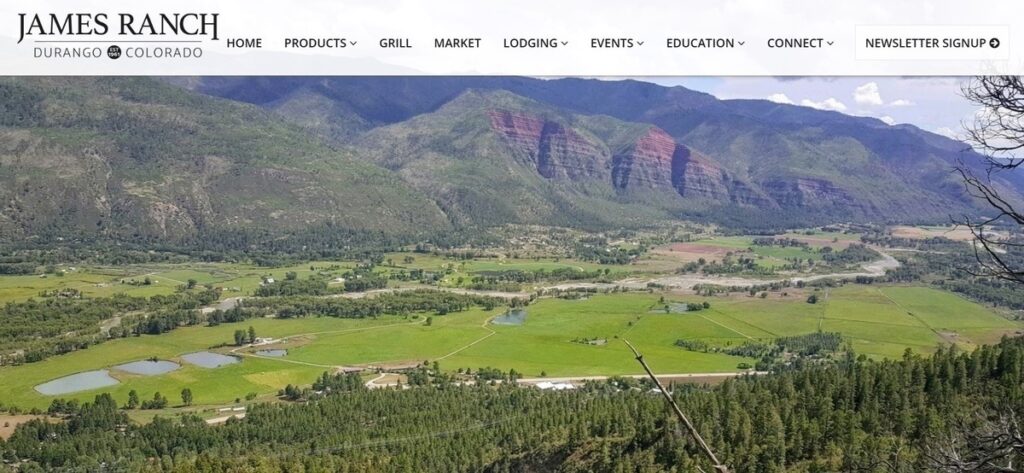
Recently I spoke with Joe Wheeling, co-owner of James Ranch Beef. His entrepreneurial journey includes growing up on a rural Montana ranch, earning a finance degree from Wharton, and leading as CEO of a national hotel chain, before returning to his country roots to build James Ranch Beef in Durango, Colorado. In our conversation, Joe shares how the James family’s unique business structure fosters both independence and community, the importance of trust and relationships in entrepreneurship, lessons learned from failure, and trends in the evolving local food movement. Joe gives some powerful advice for young entrepreneurs on grit, decision-making, and knowing when to push forward and when to pivot.
From Ranch Life to Entrepreneurship
Griffin Connolly: Alright, let’s jump right into it. Tell me a little about your background and how you found your way into both community-focused work and entrepreneurship?
Joe Wheeling: Absolutely, Griffin. I actually grew up on a ranch in rural Montana. To give you an idea of how rural—it was a one-room schoolhouse, and I was the only kid in my grade for eight years. In fact, I was the only boy in the entire school.
After high school, I went to Colorado State University and got a degree in agriculture and animal science. From there, I made a pretty big pivot and went on to the Wharton School of Business at the University of Pennsylvania. I like to joke that I was probably the most redneck person at Wharton! But I earned a finance degree there, and while I was in school, I worked for the Small Business Development Center at Wharton. This was a great experience—working with all kinds of clients, from small local businesses to some high-profile entrepreneurs.
After graduation, I went into consulting and eventually took on a corporate role as CEO of Red Roof Inn, a national hotel chain. Along the way, my wife Jenn and I also started a business here at James Ranch around 1990. Today, we own and operate James Ranch Beef, supplying our community with grass-fed beef through our market and restaurant here at the ranch.
Building a Business Model that Preserves the Land
Griffin Connolly: James Ranch has a lot going on. Can you expand on the different facets of the business and how everything came together?
Joe Wheeling: Sure. The big turning point for the ranch was back when the property was almost sold for development—think lots of houses and a golf course. As a family, we were asked what we’d each do with the money if the land was sold. Every single one of us answered that we’d want to buy back a piece of the ranch. That was a lightbulb moment. If that’s what we really wanted, then we needed to figure out a way to keep the ranch together and make it sustainable.
That’s when we started thinking differently. My wife Jenn is the oldest of James’ children, so I married into the family, and we’ve now been married 39 years. Her parents, Dave and Kay, made it clear early on: there wasn’t a job waiting for any of us here. If we wanted to come back, we needed to create our own business.
That turned out to be a great thing. It pushed each of us to be entrepreneurial. Together as a family, we worked out a high-level mission statement and agreed on some key principles. One of the big realizations was that we couldn’t survive doing traditional, commodity agriculture. We’re just too small for that model to work.
Instead, we focused on value-added agriculture—using the land in ways that increased its value while taking care of the soil and improving what we have. Buying more land wasn’t an option in Durango, especially not in the North Animas Valley where we are. So, each family member launched their own business under the broader James Ranch umbrella. Over time, there’s been succession and change, but today each business is independently owned and operated by the individual families.
This structure does two important things. First, it allows everyone to pursue their passion and be fully accountable for their business. Second, it eliminates some of the typical family business friction—where one sibling’s business success or failure might pull down the others, or there are differences of opinion on direction. Here, each business stands on its own.
Collaboration with Clear Boundaries
Griffin Connolly: That’s such an interesting model. Do you still find there’s a lot of collaboration between the different family businesses, or is it mostly independent now?
Joe Wheeling: There’s definitely still collaboration, but it’s structured. We have regular family meetings, and we even have a formal board that oversees shared family assets. That board meets monthly.
But the collaboration stays focused on collective interests—like shared land use or infrastructure—not on the day-to-day operations of each individual business. If there’s an issue with a particular business, it’s addressed privately between the families involved. That way, we maintain accountability and keep clear boundaries.
It comes to the Board level if it’s something that affects everyone. For example, if one of the businesses needs to borrow from the collective family resources. But for the most part, each business is run independently, and we all know that our individual success or failure is up to us.
Entrepreneurship and Community: Why Accountability Matters
Griffin Connolly: You touched on this earlier, but I want to dive a little deeper into the community aspect. That’s something I’m really focused on myself. Can you talk about what community means to you—both personally and as an entrepreneur—and why it’s important to you?
Joe Wheeling: Absolutely. This is something I always bring up when people ask me about getting into business. A lot of times I hear people say, “I want to be an entrepreneur because I don’t like working for other people,” or “I don’t want anyone telling me what to do.” Honestly, I think that’s a pretty poor reason to choose entrepreneurship.
The truth is, when you run a business, you work for more people than ever. You work for your customers, your employees, your community, your suppliers, and even your shareholders if you have them. Personal accountability doesn’t go away when you become your own boss—it actually increases. If you’re going to succeed, you have to deal with that in a professional and responsible way.
But when you get it right, there’s something really special about becoming a vital part of your community. When your business is essential to your community—and the community is equally essential to your business—it creates a powerful dynamic. You get loyal, passionate customers who become your biggest supporters, and you gain a real sense of purpose in the work you do.
We’ve been really fortunate here at James Ranch to become part of the fabric of the Durango community. That relationship is something we take seriously every day.
Transparency Builds Trust: A Lesson from the Beef Business
Griffin Connolly: Is there anything specific to James Ranch you can point to where the community has been especially supportive or beneficial as you’ve built the business?
Joe Wheeling: Definitely. Let me share a quick story that really shows how important that community relationship is.
Earlier this year, in our beef business, our meat processor had to raise their prices dramatically—by 35%. That’s a huge jump. Our first reaction was probably what anyone would expect—we thought, “We need to find another processor.” So, we did some research and looked at other options. But given our location here in Durango, we realized that wasn’t realistic. We’re both an oasis and an island—we’re not close to other processors, and shipping just wasn’t going to work for us.
So we made a decision: rather than scramble for a less ideal solution, we would stick with our processor and focus on communicating with our customers.
We were fully transparent about the situation. We explained why our prices were going up and outlined the factors behind the decision, and we sent the explanation out in our customer newsletter.
And the response was incredible. Even though we raised prices, the community stood behind us. We actually got a lot of positive feedback, and interestingly, our sales didn’t suffer at all. If anything, they increased.
I think that’s the power of being a trusted, authentic part of your community. When you’re honest—not just about the good news, but also about the challenges—people respect that. They want to support businesses that are open and real with them.
Learning from Mistakes: The Role of Experience and Intuition
Griffin Connolly: Sticking with the topic of challenges—are there any moments from your time at James Ranch that really stand out as being difficult? Anything you would have done differently?
Joe Wheeling: Oh, I’m sure there are plenty of things I would have done differently. But honestly, I try not to dwell on that too much. You can’t live your life looking in the rearview mirror. Mistakes happen, and the best thing you can do is take what you’ve learned and use it to make better decisions going forward.
When you encounter a similar situation again, you can say, “I’ve been here before, and I’m not going to make that same mistake.” That’s how you grow.
The truth is, even if someone handed you a perfect roadmap for how to run a business without making a single mistake, you’d still find ways to mess up. That’s just part of being human. And honestly, it’s those mistakes that shape your character and build your intuition.
I don’t believe people are born with perfect intuition. It’s something you develop over time through experience—by making decisions, dealing with consequences, and learning as you go.
Back when I was at Wharton, one of my professors gave me a piece of advice that’s stuck with me ever since: “Anyone can make the easy decisions. It’s the tough 50/50 calls that separate good managers and good leaders.”
Those are the decisions where there’s no obvious right answer—where the risk and reward are balanced, and it’s hard to know what to do. When you’re faced with a true 50/50 decision, the worst thing you can do is freeze. Overanalyzing or kicking the can down the road usually makes things worse.
The advice I got—and still follow—is to make those decisions as quickly as you can. That way, if you’re wrong, you can correct course sooner. Delaying out of fear or indecision only magnifies the problem.
So, when you realize it’s a 50/50 call, trust your process, make the best decision you can with the information you have, and be ready to pivot if you need to. And if you do make a mistake, own it, fix it, and move on.
Finding Fulfillment: Relationships Over Revenue
Griffin Connolly: That’s a really great way of thinking about failure and growth. I appreciate the idea of “acquired intuition”—it’s not something I’ve heard phrased that way before.
On the flip side of that, what would you say has been the most fulfilling part of your entrepreneurial journey?
Joe Wheeling: For me, even though my background is primarily in finance, and I grew up in a pretty isolated environment, I’ve always had an ability to connect with people. I think that’s been a huge part of what I’ve found fulfilling.
At the end of the day, it really comes down to relationships and working with others. Having a positive impact on people and building something together as a team—that’s where the real satisfaction comes from. When you work with others toward a common goal, great things can happen.
That’s just as true in entrepreneurship as anywhere else. A lot of people get into business because they want to do their own thing and be independent. And honestly, that works for some founders—they’re great at getting something started. But being a lone wolf usually doesn’t translate into long-term business success.
There are plenty of examples of founders, even famous ones, who were great at starting things but couldn’t grow or sustain the business beyond a certain point. Because at some stage, it always comes down to people—how you build your team, how you treat others, and how well you can lead.
For me, enjoying the people side of business has made all the difference. And when I think about what makes those relationships work, it really comes down to trust.
You can be full of charisma, you can be persuasive—but if people don’t trust you, that will only take you so far. Trust is at the heart of every strong team and every lasting business relationship. Being trustworthy is key to building something that lasts.
The Growing Local Food Movement: From Niche to Mainstream
Griffin Connolly: The world of food and farming has changed dramatically over the years—especially with technology and growing awareness around health and sustainability. Looking back at when you first started at James Ranch, what trends have you seen in local agriculture and consumer habits? How is it different now compared to then?
Joe Wheeling: Oh, it’s changed in a big way. When we first started, we were extremely pure in what we were doing—growing organic produce, raising grass-fed beef—but honestly, most people didn’t care. Price was king. People would look at our products and say, “Yeah, but I can get it cheaper at the supermarket”. It was frustrating at times.
Even when Jenn and I were running the gardens here at James Ranch and producing incredible, fresh vegetables, customers were still always price shopping. There just wasn’t a lot of understanding about the connection between food quality, health, and local sourcing.
But that mindset has shifted dramatically. Documentaries, books, and broader media coverage started raising awareness about healthy eating, food systems, and the health impacts of what people put on their plates. That cultural shift really turned the tide.
Today, I think we’re in a completely different position than we were 25 or 30 years ago. People are much more informed and willing to support local producers who prioritize sustainability and food quality.
Let me tell you a quick story that shows how far this movement has come. Back in the 1990s, Jenn and I went to an organic farming conference in Austin, Texas. Two of the keynote speakers were Wendell Berry and Paul Hawken. They’re seen as giants in the sustainable agriculture and environmental world today. But at that time, it was a small, intimate gathering. You could literally sit down and have lunch with them. That shows just how niche this movement was back then—and how much it’s grown since.
At the same time, while local and regenerative agriculture has gained momentum, industrialized agriculture has gotten even bigger and more industrialized. Practices like using growth implants in livestock—where before there might have been one implant used, now industrial agriculture is using multiple, pushing for maximum yields at all costs.
So really, the industry has split into two very different directions: highly industrialized, large-scale agriculture on one side, and small, regenerative, community-focused producers on the other.
Science is Catching Up
Griffin Connolly: Is there anything you’d point to as the main driver behind that change? Or has it just been a gradual increase in consumer awareness over the years?
Joe Wheeling: It’s a combination, really. For those of us on the regenerative side, it’s taken a lot of marketing, communication, and education to help people understand the value of what we’re doing. Consumer awareness didn’t just happen overnight—it’s been a long process of outreach.
Universities and research institutions have played a role too. For the longest time, anything regenerative or organic was completely dismissed by mainstream science. It was treated like a fad that would eventually go away.
But over time, there’s been more research, more data, and more validation of the environmental and health benefits of regenerative practices. Science now recognizes there are at least two sides to this conversation, whereas before there wasn’t even an effort to study alternative approaches.
It’s still an uphill battle in some ways, but we’re in a much better place than we were decades ago.
Final Advice for Young Entrepreneurs: Know When to Push and When to Pivot
Griffin Connolly: Yeah, even just since COVID, it feels like the interest in local and sustainable food has exploded. More and more people seem to be hopping on board. It’s great to see.
This has been a fantastic conversation. I’ve got one final question for you: I run a Student Launch Club at my school for young entrepreneurs and aspiring founders. If you could give us all one piece of advice what would it be?
Joe Wheeling: That’s a great question. I think so much of success comes down to grit, decision-making, and being able to honestly assess your situation.
When I was at Wharton, I remember a well-known real estate developer gave me a piece of advice that stuck with me. He said: “The key is to figure out the difference between dandruff and cancer.”
What he meant was, if you’re dealing with dandruff—a small, fixable problem—you can turn it around. But if you’re dealing with cancer—something that’s terminal and can’t be fixed—you need to recognize that too and know when to walk away.
That applies directly to entrepreneurship. Sometimes, people hold onto a bad idea for way too long, trying to force it to work when it’s clearly not viable. But just as often, entrepreneurs misjudge obstacles in front of them. What looks like a solid brick wall might actually be nothing more than a piece of paper that you can walk right through.
So, the challenge is having good, solid analytics. Understand your business, your market, and what’s really standing in your way. Some of it comes down to luck, but a lot of it comes down to fortitude and clear-headed thinking.
You need to know when to push harder—and when it’s time to pivot or let go. Missing the market entirely, or getting overtaken by new technology or competition, can mean it’s time to move on. But when the obstacle is just fear or hesitation, you’ve got to keep going and break through.
Griffin Connolly: That’s such great advice—knowing when to push forward and when to pivot. Thank you again, Joe. I really appreciate you taking the time to speak with me.
Joe Wheeling: Absolutely, it was a pleasure speaking with you Griffin. All the best in your future endeavors.
Read my previous interview with food futurist, Chris Clark here.